

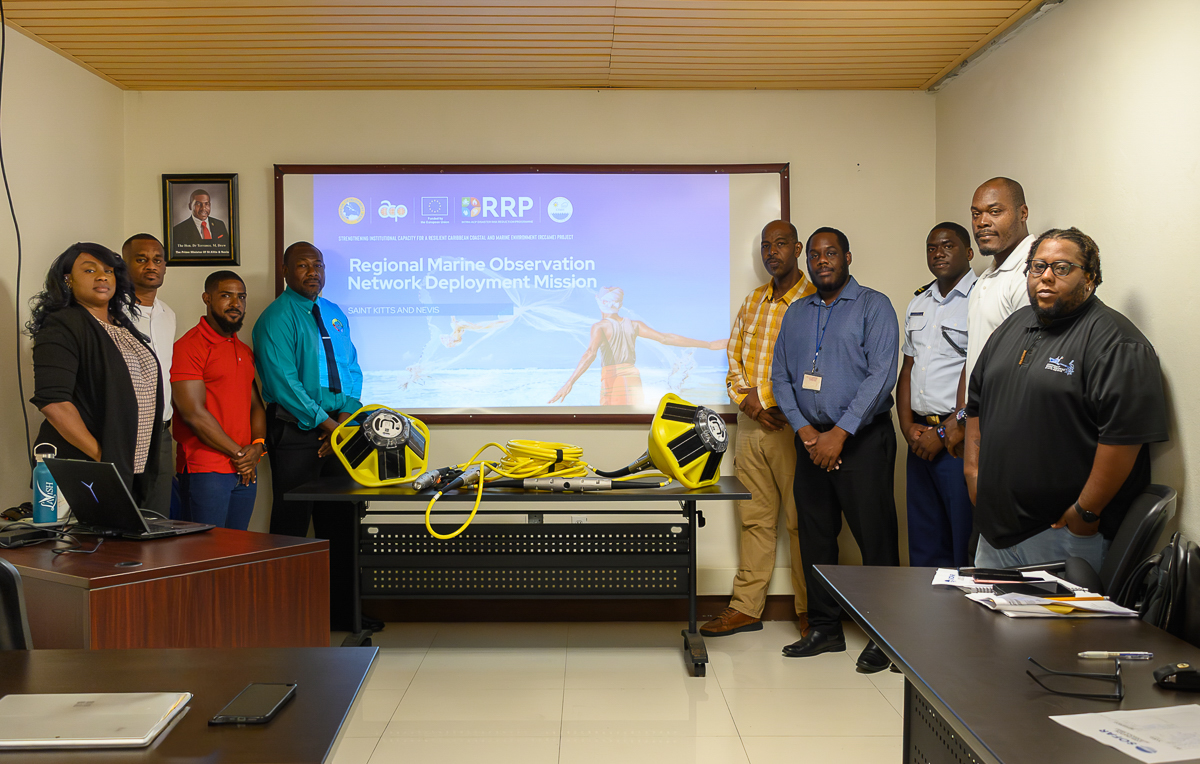
BASSETERRE, ST. KITTS, 31 August 2026 — The Federation of St. Kitts and Nevis has received three SOFAR Spotter buoys under a regional initiative designed to strengthen marine observation, technical capacity and coastal resilience across the Caribbean.
The Caribbean Institute for Meteorology and Hydrology (CIMH) formally handed over the equipment during a ceremony at 9:00 a.m. on Monday, 31 August 2026, at the St. Kitts-Nevis Coast Guard Base in Basseterre. This was followed by a technical workshop for national stakeholders on operating, deploying, maintaining, and using data from the buoys.
The three instruments will be part of an expanding regional marine-monitoring network. Two are conventional wave-monitoring buoys, and the third has a Smart Mooring temperature profiler that measures temperature at different depths. Two buoys are for waters around St. Kitts and one for Nevis, with final placement guided by technical assessments, sea conditions, water depth, seabed characteristics, cellular connectivity, and marine traffic.
The solar-powered buoys provide near-real-time observations of significant wave height, wave period, atmospheric pressure, and sea-surface temperature. The Smart Mooring unit adds a temperature profile through the water column. Data are transmitted mainly through cellular networks, with Iridium satellite communication as a backup, and can be viewed on an online dashboard for monitoring, analysis, and download purposes. Mr. Elmo Burke (Senior Meteorological Officer), said the equipment will improve the Federation’s capacity to understand marine conditions and protect those who depend on the sea.
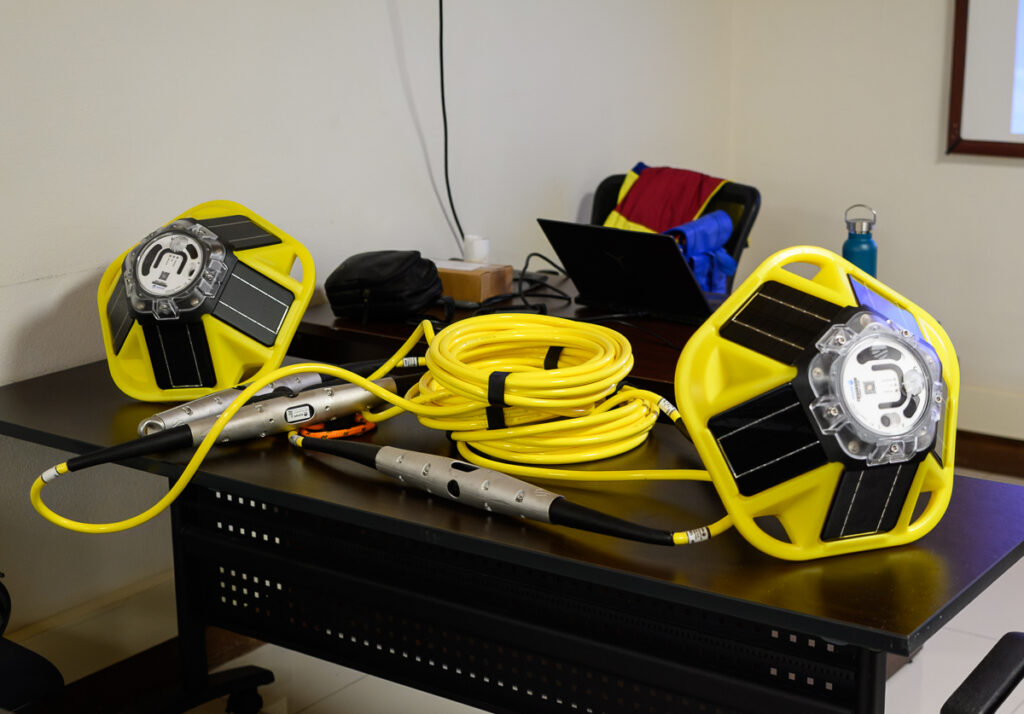
“These buoys will help us monitor wave heights, wave periods, and in selected areas, temperature profiles. The information will support improved modeling and forecasting and help us safeguard our marine users,” Mr. Burke said. “They are important national assets placed for the public’s benefit, and we ask everyone not to tamper with them.”
Mr. Burke advised fishers, boat operators, and other marine users who find a buoy at an unexpected location to contact the St. Kitts Meteorological Services, St. Kitts-Nevis Coast Guard or another relevant authority to check its status.
During the workshop, CIMH Technical Officer I – Hydroinformatics, Mr. Courtney Forde, explained the buoys’ capabilities, telemetry systems, dashboard, data-sharing options, mooring configurations, and site-selection requirements. Participants also received practical guidance on pre-deployment inspection, safe deployment and recovery, routine servicing, biofouling control, corrosion and line checks, troubleshooting, and annual maintenance.
Speaking on behalf of NEMA and the Nevis Disaster Management Department, Mr. Brian Dyer called the handover an important boost to the Federation’s marine-observation capacity. He noted that near-real-time data on wave activity and water temperatures will deepen understanding of the changing marine conditions, improve forecasting, strengthen the national Multi-Hazard Early Warning System, support enhance emergency preparedness and response, and help protect lives, livelihoods, and critical infrastructure across St. Kitts and Nevis.
Mr. Forde emphasized that sustained collaboration among national agencies and marine users will be central to maintaining the buoys and preserving the continuity of their data.
Representatives from the St. Christopher Air & Sea Ports Authority (SCASPA), National Emergency Management Agency (NEMA), St. Kitts-Nevis Coast Guard, Fisheries and Marine Resources, Maritime Affairs, the Nevis Disaster Management Department, Department of Physical Planning and other relevant agencies participated in the national initiative. The data will be made accessible to participating institutions to support forecasting, emergency preparedness and response, marine safety, fisheries, research, marine spatial planning and the protection of coastal livelihoods and infrastructure.
The initiative is part of the project Strengthening Institutional Capacity for a Resilient Caribbean Coastal and Marine Environment. It is funded by the European Union through the Caribbean Development Bank, with CIMH serving as the executing agency. Marine Observation and Services is one of six project components, alongside air-quality monitoring, high-resolution climate prediction modeling, cascading-hazard frameworks, data analytics and knowledge exchange, and climate and health research.
The wider program is being implemented across 15 member states of the Caribbean Meteorological Organization. St. Kitts and Nevis is the fourth participating country to receive the buoys, marking a significant step toward a more coordinated regional ocean-observation network.
By expanding access to reliable marine data, the new equipment will strengthen early warning, support evidence-based decision-making, and contribute to national and regional research efforts to protect lives, livelihoods, and critical infrastructure from coastal and ocean-related hazards.
— END —
FOR MORE INFORMATION, CONTACT
St. Kitts Meteorological Services
Robert L. Bradshaw Airport
St. Christopher Air and Sea Ports Authority
Email: skbmetoffice@scaspa.com