

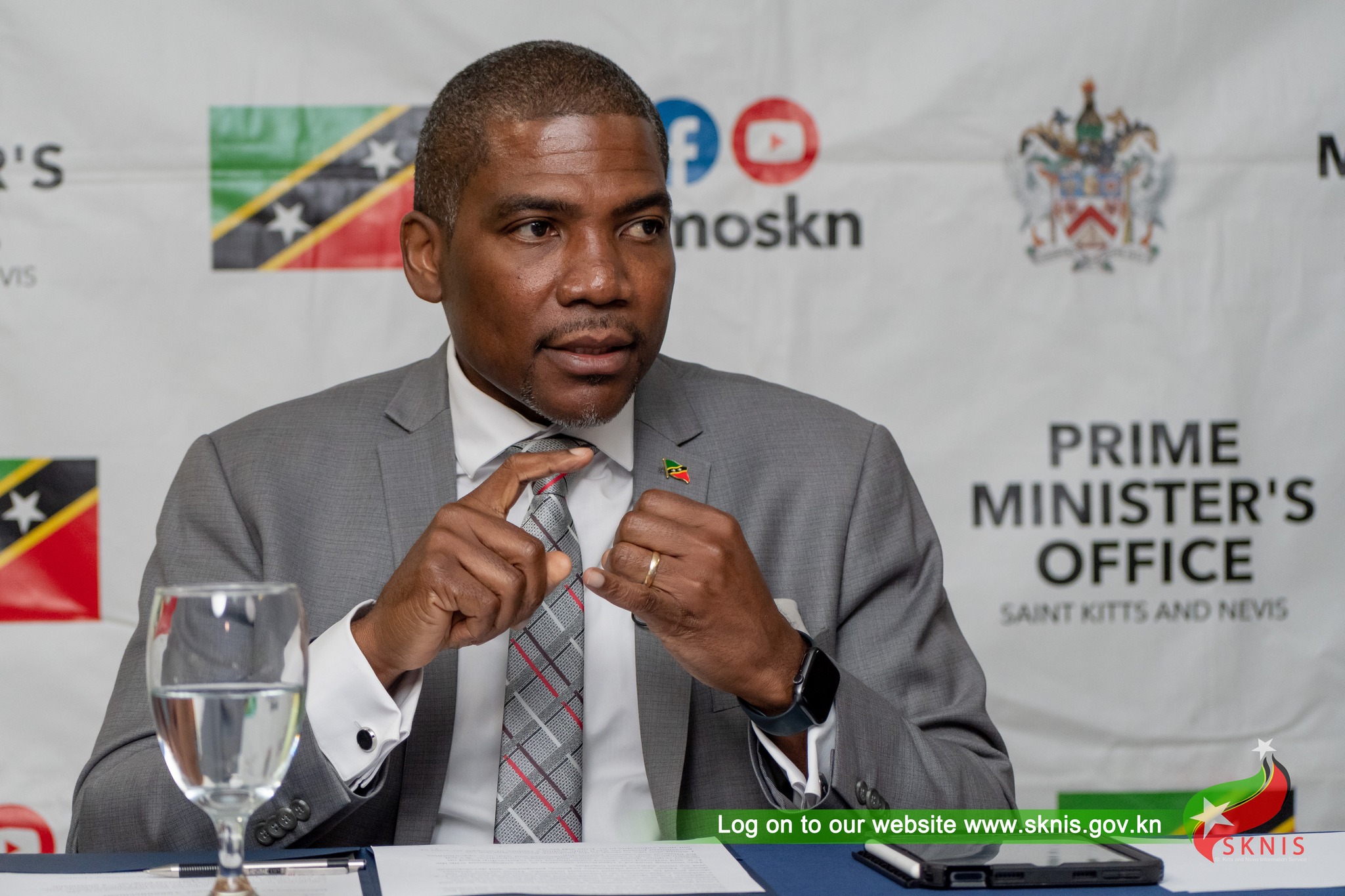
Basseterre, St. Kitts, November 16, 2026 (PMO) – Protecting and preserving the banking relationships that allow families to receive money from abroad, businesses to pay overseas suppliers and visitors to use their credit cards was central to the Government’s decision to wind down the Citizenship by Investment (CBI) Programme, Prime Minister Hon. Dr. Terrance Drew said in his national address aired on November 13th.
Prime Minister Drew said the Government had formally conveyed its decision to the European Union (EU) and was negotiating a timeline for the transition. He explained that the decision took into account the risk of financial blacklisting and the consequences for households and businesses if international banks were to withdraw services that local banks rely on to move money across borders.
“Our banks depend on banks in the United States, Canada, and Europe to move money in and out of this country. If those banks cut us off, a visitor could not pay with a credit card. A family abroad could not send money home. A business could not pay for goods it imports,” Prime Minister Drew explained.
Those banking relationships, known as correspondent banking relationships, connect local banks to the international financial system. Dr. Drew said losing access to those services would have serious consequences for tourism, banking and offshore education, all of which depend on the ability to send and receive payments internationally. “No responsible leader will gamble with that. I will not gamble with that. You are too important,” he said.
The Prime Minister said the European Commission invited St. Kitts and Nevis in June to wind down the programme over a transition period with a view to preserving visa-free travel to the Schengen area. The approach followed a revision of the EU’s visa suspension rules, which took effect on December 31, 2025. Under the revised rules, operating an investor citizenship programme that grants citizenship to individuals without a genuine link to the country is grounds for the EU to consider suspending visa-free travel.
Prime Minister Drew pointed to measures the Government had already taken to strengthen the programme, including applicant interviews, additional checks by the Financial Intelligence Unit and independent audits. In February 2026, the United States Treasury’s Financial Crimes Enforcement Network (FinCEN) rescinded its 2014 advisory concerning the programme, a development the Government welcomed as a milestone in its reform efforts.
The Prime Minister reassured citizens at home and abroad that the decision had no immediate effect on their citizenship or travel arrangements. He said the CBI Programme would continue under strict vetting and oversight during the transition, and that he would announce the final date for receiving applications once it was agreed with the EU.