

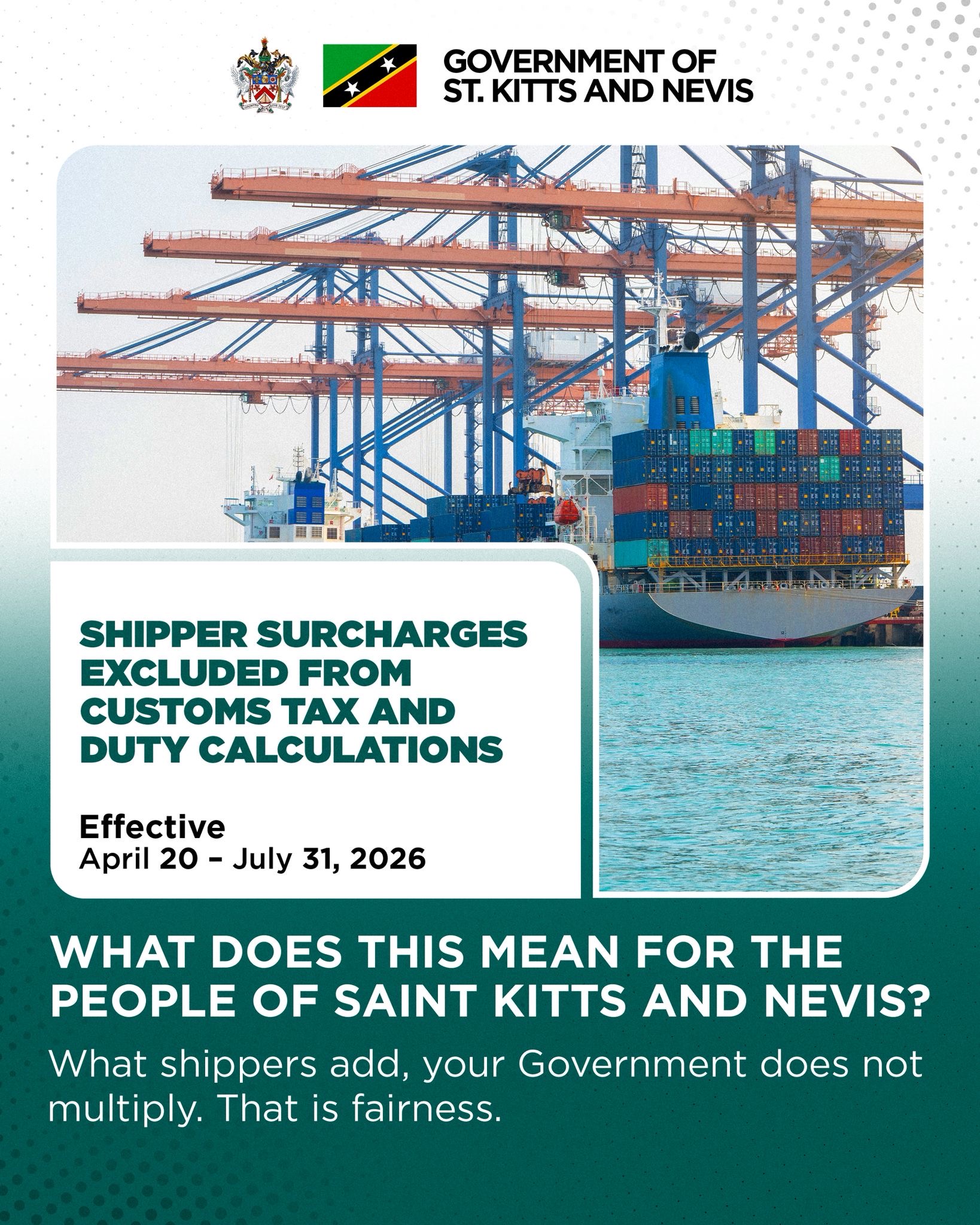
Basseterre, Saint Kitts, June 05, 2026 (SKNIS): As part of its ongoing efforts to address rising cost-of-living challenges and protect citizens and residents from increasing global prices, the Government of Saint Kitts and Nevis is reminding the public and the business community of the customs relief measures currently in effect, including the waiver of bunker and shipper surcharges from customs tax and duty calculations.
Introduced under the government’s economic relief package announced in April 2026, the measure was specifically designed to help ease cost-of-living pressures by reducing the impact of escalating international fuel and freight costs on the prices of imported goods. By excluding bunker surcharges associated with sea and air freight from the Customs Value (CIF) used to calculate customs duties and taxes, the government has taken deliberate action to prevent consumers from bearing additional costs generated outside the Federation’s control.
The waiver recognises that recent increases in shipping and transportation charges are largely the result of external economic factors, including fluctuations in global fuel prices and international supply chain pressures. These developments have contributed to higher costs worldwide and have intensified cost-of-living concerns in many countries, including Saint Kitts and Nevis.
By removing these surcharges from the customs valuation process, the government has reduced the tax burden attached to imported goods, providing relief to importers and creating opportunities for savings to be passed on to consumers. The measure forms part of a broader strategy aimed at reducing cost-of-living pressures, cushioning households and businesses from international economic shocks, and helping to stabilise prices within the local economy.
The customs surcharge waiver is one of several temporary relief measures implemented by the government. Other initiatives include a 50 percent reduction in the excise tax on gasoline, a reduction in the Customs Service Charge on gasoline from six percent to three percent, and the removal of Value Added Tax (VAT) on qualifying alternative energy equipment and devices.
Together, these measures demonstrate the government’s commitment to tackling the cost of living through practical and targeted interventions that provide meaningful relief to families and businesses while strengthening national economic resilience.
The economic relief measures remain in effect through July 31, 2026.
End